
Ripple is now capitalizing on the demand for leveraged exchange-traded funds (ETFs), providing financial means to track and magnify daily stock market movements. This move positions Ripple, traditionally seen as a crypto-centric enterprise, firmly into a domain often populated by major banks and securities firms through its brokerage arm, Ripple Prime.
Leveraged ETF Financing Mechanism Explained
Leveraged ETFs can achieve their target returns through financial contracts known as “total return swaps” instead of directly investing in large quantities of stocks. For instance, a fund targeting twice the daily return of Nvidia shares might engage in a financial swap instead of buying twice the stock’s value.
The brokerage provides the desired market position through a swap agreement and earns a financing fee, offsetting its risk through other stock purchases and transactions.
As reported by the Wall Street Journal, Ripple is poised to earn a financing rate reflecting four percentage points above the overnight borrowing costs to banks from the Tradr 2X Long SNDK Daily ETF. This translates to an approximate annualized rate of 8%, applied to the swap agreement’s position size and separate from ETF management fees.
Hidden Road Acquisition Advances Corporate Finance Ambitions
Ripple’s foothold in the leveraged ETF segment was cemented with its $1.25 billion acquisition of multi-asset prime brokerage company Hidden Road in October 2025. The purchase endowed Ripple with a robust infrastructure, facilitating transactions and clearing services across equities, bonds, currencies, and digital assets.
Ripple launched its Delta One offerings, aligned with U.S. equities, market indexes, and digital assets, announcing in August that it possessed over $1 billion in net capital to meet regulatory requirements. Additionally, the company completed a $275 million borrowing deal with repayment priority to foster growth.
Ripple also broadened its arrangement with hedge fund manager Brevan Howard, establishing Ripple Prime as a multifaceted provider for brokerage, clearing, and financing services across different asset classes.

Participating in leveraged ETF financing enables Ripple to harness fee incomes linked to equity transactions and corporate financing. However, the extent to which this venture enhances revenue or employs XRP or the XRP Ledger remains undisclosed.
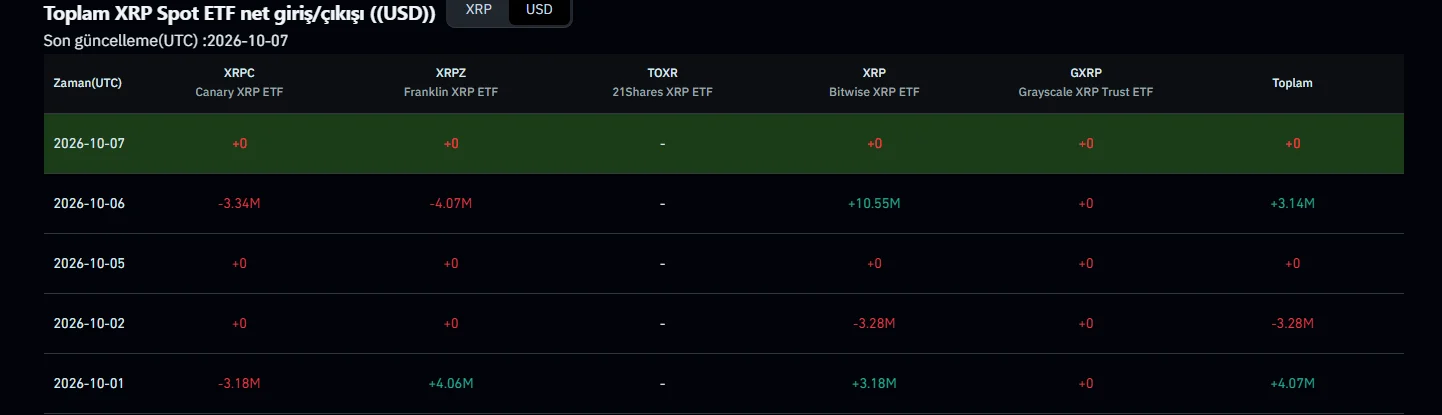
Spot XRP ETFs See $3.93 Million Inflows in October
In contrast, spot XRP ETFs reported an inflow totaling $3.14 million net on October 6. A substantial $10.55 million influx into Bitwise XRP ETF counteracted $3.34 million and $4.07 million outflows from Canary and Franklin XRP ETFs, respectively. On October 1, the net inflow reached $4.07 million: Franklin and Bitwise received $4.06 million and $3.18 million, while Canary saw a $3.18 million withdrawal. The period on October 2 witnessed Bitwise-led outflows of $3.28 million shifting the net flow into the negative.
According to Coinglass data, between October 1 and 7, spot XRP ETFs accumulated a total net inflow of $3.93 million.
Ripple’s foray into leveraged ETF financing boosts its presence in conventional financial markets, while net inflows to spot XRP ETFs suggest a sustained interest in XRP. However, the direct correlation between Ripple’s corporate expansion and XRP demand remains vague.
Ripple’s lack of disclosure regarding the use of XRP or the XRP Ledger in these financial activities limits immediate uplift signals for XRP, currently valued at $1.41 by CryptoAppsy.