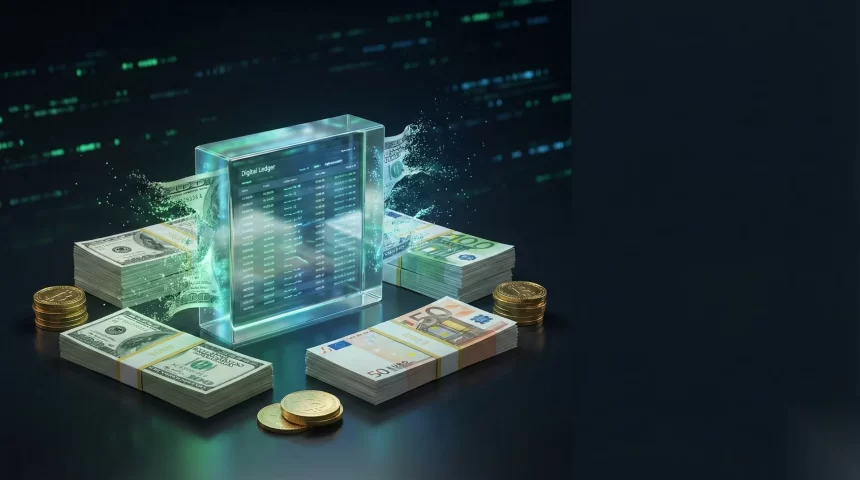
In recent times, the concept of tokenizing real-world assets (RWAs) has captured significant attention. These RWAs refer to the digital conversion of tangible assets such as government bonds, market funds, gold, credits, stocks, and real estate onto blockchain platforms. The ultimate aim of this tokenization is to leverage blockchain for improved accessibility, programmability, and traceability of traditional financial instruments.
What Are Distributed and Represented Assets?
RWA.xyz has redefined the tokenized asset landscape by categorizing it into Distributed and Represented Assets. Distributed Assets are tokenized liabilities capable of moving across wallets, stressing their portability. Meanwhile, Represented Assets mainly utilize blockchains for logging and reconciliation without freedom of circulation. This clarification enhances the understanding of distribution within the RWA market’s digital expanse.
How Does Tokenization Work?
The tokenization process starts by choosing a physical asset. This is followed by establishing structures for ownership, custody, compliance, and valuation, concluding with issuing a blockchain token. The token acts as a proxy for economic rights but doesn’t replace the asset itself. It provides a digital equivalent for ownership and transactional rights.
RWA.xyz clarifies that tokenized RWAs redefine infrastructure by transforming the processes of issuance, custody, transfer, user access, and reporting.
Why Are RWAs Important?
The significance of RWAs continues to rise as they transition traditional assets onto blockchains. This shift allows for always-available access, rapid settlements, and reduced costs. By splitting expensive assets into smaller parts, ownership becomes more attainable. When legally structured, these tokenized forms can integrate seamlessly with decentralized financial applications. However, it’s essential to acknowledge that merely moving assets on-chain does not guarantee liquid markets.
As of the year 2026, data indicates the market value of Distributed Assets is around $26.5 billion, contrasting Represented Asset Value at $363.78 billion. There are currently 692,148 unique asset holders. Stablecoins dominate, valued at $300.17 billion with 239.71 million users.
Concrete observations include:
- The dominance of broadly defined RWAs with stablecoins leading the charge.
- Government bonds remain prominent with tokenized products such as USYC and BUIDL maintaining high values.
- The tokenized commodity sector sees gold-backed tokens like XAUT taking the spotlight.
- The burgeoning equity segment highlights untapped potential.
Who Leads the Blockchain Realm in RWA Distribution?
Ethereum maintains its position as a preeminent network for RWAs with the highest distribution value of $15.3 billion. Following Ethereum, networks like BNB Chain, Solana, Stellar, and Liquid Network are emerging contenders with increasing growth rates.
Who Are the Pivotal Platforms in the RWA World?
Securitize is at the forefront of RWA platforms with $3.04 billion in assets. Other significant players like Maple, Circle, and Paxos further prove the growing interest of established financial giants in the RWA space.
What Are the Challenges Facing RWAs?
Despite advancements, the RWA model faces hurdles such as requiring solid legal frameworks, transparent custodianship, and credible issuance. Furthermore, barriers such as compliance and regional laws continue to limit unfettered decentralized trading.
RWA stands as a significant connective layer between blockchain technology and traditional economic structures. Transforming conventional assets into a digital format signals a shift that could redefine capital markets. However, stablecoin prevalence and the nuanced classification of RWA assets are vital for evaluating ongoing advancements within this expanding domain.