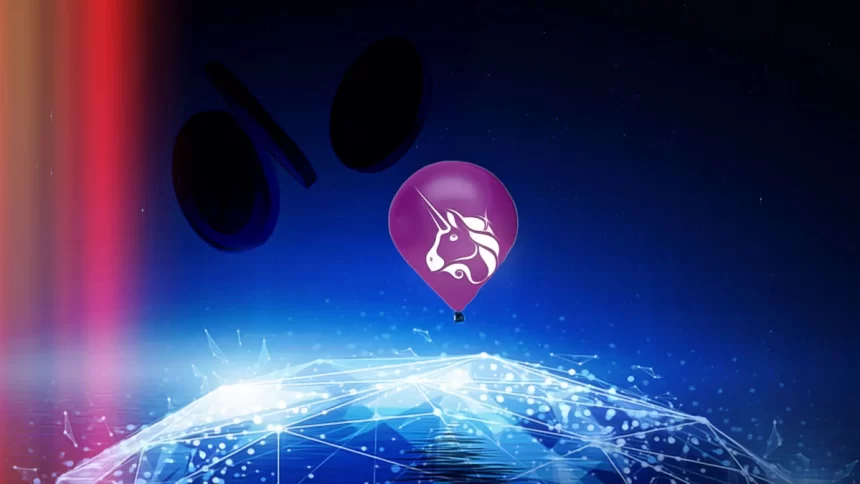
Uniswap DAO has put forth a strategic proposal to broaden its fee collection and UNI token burn strategy across BNB Chain, Polygon, and Celo. This initiative, if adopted, would embed these networks into the growing Uniswap ecosystem, bolstering its multi-chain endeavors and extending its current reach beyond Ethereum and other primary networks.
Is May 2026 the Decision Month for the Community?
The proposal, dubbed “Protocol Fee Expansion: Vote 3” (Proposal #96), is live on Uniswap’s governance portal, with community voting slated to commence on May 24, 2026. Approval would mean these new chains will adopt the fee-burning process, already functional on several networks like Ethereum, Arbitrum, and Base.
On BNB Chain and Polygon, fees from v2 pools will find their way to the TokenJar smart contract, with v3 operations handled by the advanced V3OpenFeeAdapter contract. Implementing these changes on Celo poses additional challenges due to past technical complications, necessitating the use of cross-chain accounts for some tasks.
What Could This Mean for Uniswap and UNI Token?
The UNIfication program, which began in December 2025, links fee collection and burning directly to heightened UNI token activity. From its commencement, UNI prices surged from $4.95 to $9.25 in a short period, indicating strong market reception.
In March, 139 million UNI backed Proposals 94 and 95, paving the way for expanding the fee mechanism to an additional eight blockchains.
With Proposal 96, the number of UNIfication-enabled chains would rise to eleven. On these platforms, 0.3% trading fees from v2 pools would be split, rewarding liquidity providers with 0.25% and allocating 0.05% for the protocol. For v3 pools, the new adapter’s contracts would define fee parameters.
An Insight into Uniswap’s Financial Health
According to Defillama, Uniswap’s aggregate protocol fees across chains tally up to $5.57 billion. It generates about $477 million annually, with $3.3 billion locked in on its platform currently. Notably, BNB Chain has added $117 million in TVL and $3.53 million in 30-day fees, with Polygon contributing $76.5 million in TVL and $1.02 million in recent fees.
The following insights provide valuable takeaways from the ongoing developments with Uniswap:
– Uniswap’s multi-chain integration could significantly boost its ecosystem.
– More networks could enhance the liquidity and utility of the UNI token.
– Implementation complexities on Celo prompt technical innovations.
– Fast-tracked governance is pivotal for swift decision-making.
Though UNI is currently trading at $3.30, a drastic fall from its peak of $44.97 in May 2021, the next phase of UNIfication could revitalize its market standing. Uniswap founder Hayden Adams co-authored the proposal, underscoring the DAO’s dedication to these forward-looking changes.
The newly introduced governance framework with UNIfication will allow fee parameters discussed in community forums to rapidly transition to on-chain voting, ensuring that essential amendments are executed without undue delays.